.webp)
What Multi-Cloud Strategy Actually Means
Most companies start their cloud journey the simple way. They pick one provider, usually AWS, Azure, or Google Cloud, and build everything on top of it. That works fine until the company gets big enough that a single vendor starts controlling too much of the business. Pricing power shifts to the provider. Outages take down everything at once. And switching later becomes nearly impossible because the entire stack is wired into one ecosystem.
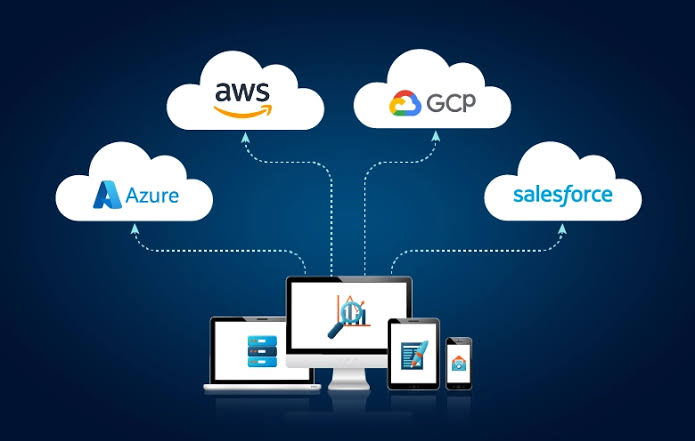
Multi-cloud strategy is the deliberate decision to avoid that trap. Instead of committing to one provider, a company runs its workloads across two or more cloud platforms, choosing whichever provider fits a given task best. Storage might sit on one cloud, machine learning workloads on another, and core transactional systems on a third or on private infrastructure the company owns outright.
This is different from hybrid cloud, which mixes public cloud with on premise or private data centers. Multi-cloud is about spreading workloads across multiple public providers, though in practice, as you will see with Walmart, the two approaches often get combined.
Why Big Companies Actually Do This
The reasons rarely come down to a single factor. In most enterprise cases, it is a combination of:
Avoiding vendor lock-in. Once your entire codebase, data pipelines, and internal tooling are built around one provider's proprietary services, leaving becomes a multi year project. Multi-cloud keeps that door open.
Cost leverage. When a company can run the same workload on more than one platform, it has real negotiating power. Providers know the business can walk, which changes the pricing conversation completely.
Resilience. If one provider has a regional outage, and every major cloud provider has had one, a multi-cloud setup lets traffic fail over instead of going dark.
Best of breed tooling. Each provider has areas where it genuinely leads. Some are stronger in AI and data analytics, others in enterprise integration, others in raw compute pricing. Multi-cloud lets a company use each provider for what it does best instead of settling for one vendor's weakest offering because it happens to be bundled.
Competitive separation. Sometimes the reason is not technical at all. It is strategic distance from a competitor.
Case Study: Walmart's Multi-Cloud Infrastructure
Walmart is one of the clearest real world examples of multi-cloud strategy executed at massive scale, and its reasoning touches nearly every point above.
The Competitive Reason Behind the Architecture
Walmart is the second largest retailer in the world, sitting directly behind Amazon. Amazon Web Services is the largest cloud provider on the planet, and it is also owned by Walmart's biggest competitor. Running core retail infrastructure on a competitor's cloud was never going to be an option Walmart's leadership was comfortable with long term.
So Walmart chose Microsoft Azure as its primary cloud partner, building a strategic, multi year partnership around it. But Walmart did not stop at swapping one single vendor for another. That would have just traded one form of lock-in for a different one. Instead, Walmart built an architecture designed to run workloads across Azure, Google Cloud, or its own privately built infrastructure, depending on what each workload needed.
The Walmart Cloud Native Platform
At the center of this is something Walmart built in house starting in 2020, called the Walmart Cloud Native Platform, or WCNP. This is a Kubernetes based system that Walmart engineered from the ground up rather than buying off the shelf.
Kubernetes matters here because it is the piece that makes true multi-cloud possible. Kubernetes packages applications into containers that behave the same way regardless of which physical cloud they run on. Once your workloads are containerized and orchestrated this way, moving them between Azure, Google Cloud, or Walmart's own data centers becomes a configuration decision instead of a rebuild.
This is the technical detail that most companies attempting multi-cloud get wrong. They assume multi-cloud means simply having contracts with two providers. In reality, it requires an abstraction layer, in Walmart's case Kubernetes and WCNP, that lets workloads move without being rewritten for each environment.
The Triplet Model
Walmart's engineering teams describe their approach internally as a Triplet Model, referring to the three environments any given workload can run in: Walmart's own private cloud, Google Cloud Platform, and Microsoft Azure.
This shows up clearly in Element, Walmart's internally built machine learning platform. Data science teams at Walmart needed a way to train and deploy models without getting stuck depending on a single vendor's AI tooling. Element was built specifically to abstract away which cloud a given ML workload actually runs on, so a model developed on the platform can be deployed to Walmart's private infrastructure, to Google Cloud, or to Azure, whichever offers the best performance, cost, or availability for that specific job at that specific time.
That is multi-cloud strategy applied at the platform level, not just the contract level.
Why This Split Makes Sense
Azure and Google Cloud bring things to the table that would be expensive and slow for Walmart to build from scratch, particularly artificial intelligence services, machine learning tooling, and other managed capabilities. Renting that expertise from established providers makes more sense than reinventing it internally.
At the same time, Walmart's leadership has been direct about the underlying philosophy. According to Walmart's own vice president of infrastructure services, the core lesson for any company managing cloud costs comes down to one word: choice. Locking into a single provider, regardless of company size, tends to push costs higher over time simply because the leverage disappears.
The Result
Walmart has publicly credited this multi-cloud, Kubernetes based architecture with cutting millions of dollars in IT costs. More importantly for a company of Walmart's scale, it gives their engineering teams the ability to route workloads based on real technical and financial tradeoffs instead of being stuck with whatever a single provider charges for a given service.
What Smaller Companies Can Actually Learn From This
Very few businesses need Walmart's scale of infrastructure, and most should not try to replicate a Triplet Model on day one. But the underlying principles apply regardless of company size.
Build with portability in mind from the start. Containerizing applications early, even on a single cloud, makes a future multi-cloud or vendor switch realistic instead of theoretical.
Avoid deep dependency on proprietary, non portable services unless the tradeoff is genuinely worth it. Every proprietary API you build directly into your core systems is a future migration cost.
Treat vendor leverage as a real asset. Even the ability to credibly threaten a switch changes pricing conversations with providers.
Match the provider to the workload instead of forcing everything onto one platform because that is where you started.
Multi-cloud is not really about using more cloud providers for its own sake. It is about making sure no single company outside your own has unchecked control over how your infrastructure runs, what it costs, and how fast you can change direction when the business needs it. Walmart's version of this took years and enormous engineering investment to build. The mindset behind it, choice over dependency, is something any company can start applying today.