.webp)
Google's Project Suncatcher: The Plan to Move AI Data Centers Into Space
Introduction:
Imagine running the world's most powerful AI systems not from a data center buried in a desert or tucked into a cold Nordic valley, but from satellites quietly orbiting the Earth, powered entirely by sunlight.
That is exactly what Google is working on.
The project is called Project Suncatcher, and while it sounds like science fiction, it is moving from the drawing board into real engineering, with prototype satellite launches expected as early as 2027.
What Is Project Suncatcher?
Project Suncatcher is Google's initiative to place AI data centers in space. The core idea is simple: instead of building more power-hungry facilities on Earth, why not move the compute into orbit where energy is unlimited and free?
Here is how the system is designed to work:
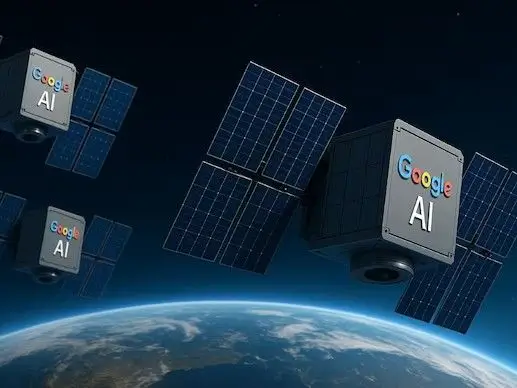
Solar-powered satellites equipped with Google's custom TPU (Tensor Processing Unit) chips would orbit the Earth. These satellites would be bathed in constant sunlight, with no clouds, no night, and no seasonal changes. They would communicate with each other and with ground stations using high-speed laser links, sending data across vast distances without the delays of traditional radio signals.
The goal is to create an orbital computing network that can run AI workloads continuously, using clean solar energy, with none of the land or power constraints that limit data centers on Earth.
Why Is Google Doing This?
The honest answer is: AI is consuming an enormous amount of electricity, and it is only getting worse.
Modern AI models require massive computing power to train and run. Every time you use an AI assistant, generate an image, or ask a chatbot a question, servers somewhere are working hard and burning power. Data centers globally already consume around 1 to 2 percent of the world's electricity, and that number is climbing fast as AI adoption accelerates.
On Earth, this creates real problems. Power grids in many regions are already strained. Building new data centers requires land, permits, cooling systems, and water. Renewable energy supply is inconsistent because the sun does not always shine and wind does not always blow.
Space solves all three problems at once. Satellites in orbit receive constant, uninterrupted sunlight. There is no land cost. And the vacuum of space provides natural cooling with no expensive cooling towers or water systems needed.
In short, Google is trying to move compute into orbit as a long-term solution to the energy bottleneck of AI.
Where Is the Project Right Now?
As of 2025, Project Suncatcher is in its late experimental phase. Google is preparing prototype satellites that would test the key technologies involved, particularly the TPU chips operating in a space environment and the laser communication links between satellites.
The first real-world prototype launches are expected around 2027. This is not a guaranteed commercial rollout. It is a testing phase. But it represents a significant leap from pure theory into hardware engineering.
The fact that Google is willing to commit resources to prototype launches signals that internal confidence in the concept is growing.
The Challenges: Space Is Not Easy
No project this ambitious comes without serious obstacles. Scientists and analysts have raised several concerns about the feasibility and safety of orbital computing networks.
Space Traffic and Debris
Low Earth orbit is already crowded. Thousands of active satellites from companies like SpaceX, Amazon, and others are already operating there. Adding Google's network could increase the risk of collisions, and a collision in orbit creates debris that can threaten other satellites, a cascading problem known as the Kessler Syndrome.
Managing orbital slots, coordinating with international space agencies, and ensuring satellites can safely deorbit at end-of-life will all be critical challenges.
Harsh Environment
Space is not kind to electronics. Satellites face radiation, extreme temperature swings, and micrometeorite impacts. Engineering TPU chips that can survive and perform reliably in that environment for years at a time is a significant technical hurdle.
Cost
Launching hardware into space is expensive. While costs have dropped dramatically thanks to companies like SpaceX, putting enough satellites into orbit to run meaningful AI workloads will still require enormous capital investment. The economics need to work out for this to scale beyond a research experiment.
Google Is Not Alone
What makes this story more significant is that Google is not the only tech giant thinking along these lines.
Elon Musk and SpaceX are actively exploring orbital computing concepts, leveraging their existing Starlink satellite infrastructure as a potential backbone. Other technology companies and defense contractors are also researching space-based computing for both commercial and strategic purposes.
This is becoming an industry trend, not a single company's moonshot.
The underlying logic is compelling enough that multiple well-funded organizations are investing in it independently. When several major players converge on the same idea from different angles, it is usually a signal that the idea has real merit.
What This Means for the Future
Project Suncatcher represents a fundamental rethinking of where computing lives.
For decades, the assumption has been that data centers belong on the ground, close to power grids, fiber optic cables, and human infrastructure. That assumption is now being questioned.
If orbital computing works, the long-term implications are enormous. AI could scale without being bottlenecked by Earth's energy infrastructure. Clean solar power in space could replace fossil-fuel-dependent data centers. Countries without the land or grid capacity to host large data centers could access cloud computing from orbit.
It will not happen overnight. The 2027 prototype launches are a first step, not a finish line. But for the first time, the idea of AI in orbit is an engineering project, not just a thought experiment.
Simple Summary
Google is not just doing space research. It is seriously testing the idea of running AI data centers in orbit using satellites powered by the sun, with first real tests expected around 2027. The project is driven by AI's growing energy demands, and Google is not alone. SpaceX and other tech companies are exploring the same frontier.
The cloud, quite literally, is going orbital.
Follow our page for more deep dives into the technologies shaping the future of AI and tech. We break down complex stories into simple, powerful insights you can actually use.