.webp)
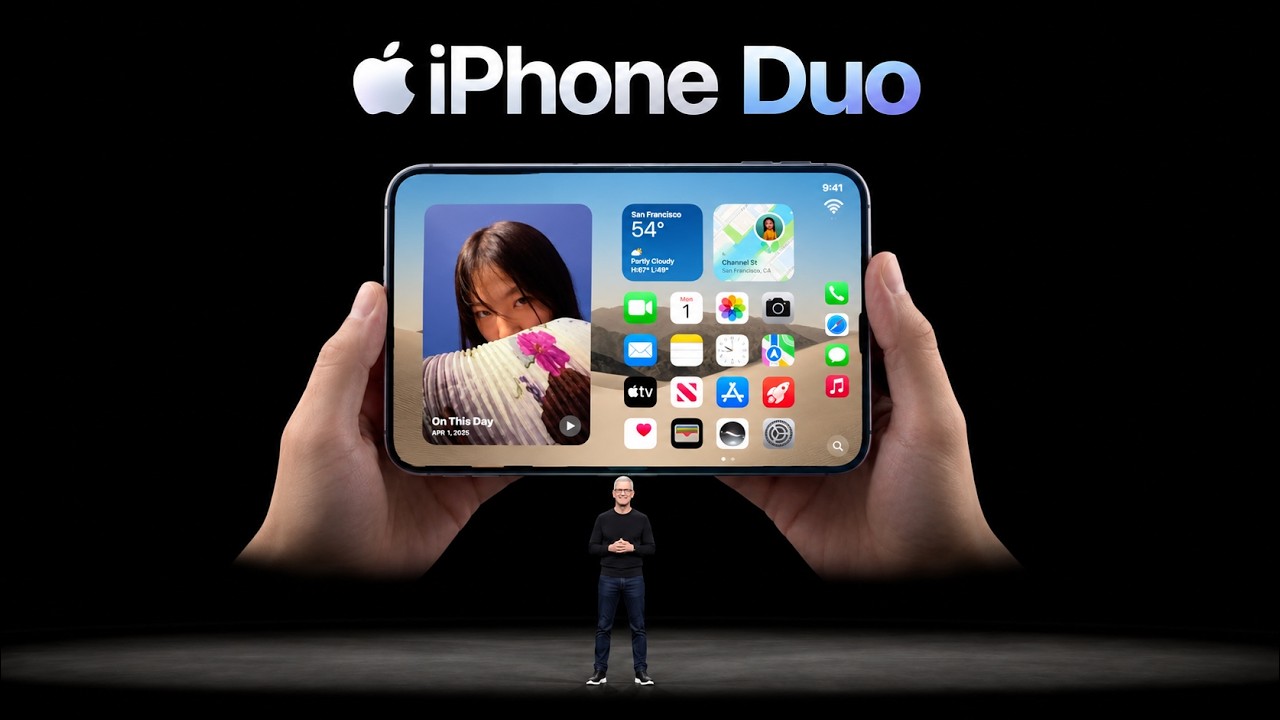
For over half a decade, flexible displays belonged primarily to tech enthusiasts and early adopters. Samsung’s Galaxy Z Fold series defined the category, establishing both the technical possibilities and the mechanical vulnerabilities of folding devices. However, Apple's unveiling of the iPhone Duo marks an undeniable inflection point for the consumer electronics industry. By bringing iOS into a dynamic dual-screen workspace, Apple has elevated foldable hardware from an experimental product tier into the central mainstream conversation.
7.6" --- Inner Super Retina
5.4" --- Outer Cover Screen
$1,999 --- Starting Entry MSRP
Engineering Beyond the Crease
The primary barrier to universal foldable adoption has long been structural integrity and display crease visibility. Early iterations of folding phones suffered from fragile screen layers, visible indentations down the middle, and hinges prone to debris ingress over extended usage cycles.
With the iPhone Duo, Apple addresses these pain points through a titanium dual-axis hinge paired with flexible micro-laminated glass. Rather than forcing a sharp fold, custom internal mechanical assemblies allow the display layers to glide smoothly, significantly relieving bending stress. When opened, a titanium structural base plate reinforces the 7.6-inch inner display to minimize visible creasing.
Samsung, now on its mature Galaxy Z Fold series, has spent years refining display durability, weight reduction, and outer screen usability. The Korean tech giant's head start has yielded thinner chassis profiles and water-resistance ratings that took years of iteration to perfect. Apple's entry forces Samsung to innovate beyond incremental updates, setting off a new mechanical engineering arms race centered around thinness, materials, and long-term display resilience.
Special Hardware Report • iPhone Duo Market ImpactPage 1
Software Adaptation: iOS 27 vs. One UI
Hardware alone does not win form-factor transitions; the operating system must justify the physical footprint and steep price point of a folding device. Samsung’s One UI has built years of multi-window features, floating toolbars, and desktop-class multitasking via DeX mode, appealing directly to power users.
Continuity Canvas
Scales active tasks from the 5.4-inch outer display to the full 7.6-inch inner canvas instantly upon opening the device.
Split-System Tasking
Powered by A20 Pro silicon, the OS runs two active app instances side-by-side with fluid drag-and-drop integration.
Head-to-Head Specification Comparison
Feature Category | Apple iPhone Duo | Samsung Galaxy Z Fold 8 |
|---|---|---|
Main Display | 7.6-inch Super Retina XDR (Nano-Texture) | 8.0-inch Dynamic AMOLED 2X |
Cover Display | 5.4-inch (Compact Outer Profile) | 6.5-inch (Standard Aspect Ratio) |
Silicon Architecture | Apple A20 Pro (2nm Process) | Snapdragon 8 Gen 5 for Galaxy |
Camera System | Dual 48MP Fusion (Main & Ultra-Wide) | Triple System (200MP Main, Ultra-Wide, Telephoto) |
Biometrics | Side-Button Touch ID | Under-Display Fingerprint |
Base MSRP | $1,999 (256GB Base) | $1,899 (256GB Base) |
Market Expansion & Supply Chain Impact
Apple’s entry into a hardware category typically generates a halo effect that benefits the broader supply chain. Panel manufacturers, hinge suppliers, and ultra-thin glass fabricators are scaling production capacities to meet the demand generated by both tech giants.
Global Foldable Smartphone Shipments (Millions of Units)
0M15M30M45M202418M202525M2026 (Est)38M2027 (Proj)48M
The $2,000 Super-Flagship Standard
With entry prices hovering around $1,899 to $1,999, both devices establish a distinct "ultra-premium" tier above standard pro smartphones. At nearly double the cost of a standard flagship, these devices must serve as true dual-purpose machines—functioning as a compact phone in the pocket and a high-performance tablet on demand.
The Strategic Takeaway
The launch of the iPhone Duo proves that foldable devices are no longer a passing experiment. Dual-screen form factors have officially arrived as the flagship hardware standard, setting off an exciting era of competition that will drive innovation across the entire mobile ecosystem.