.webp)
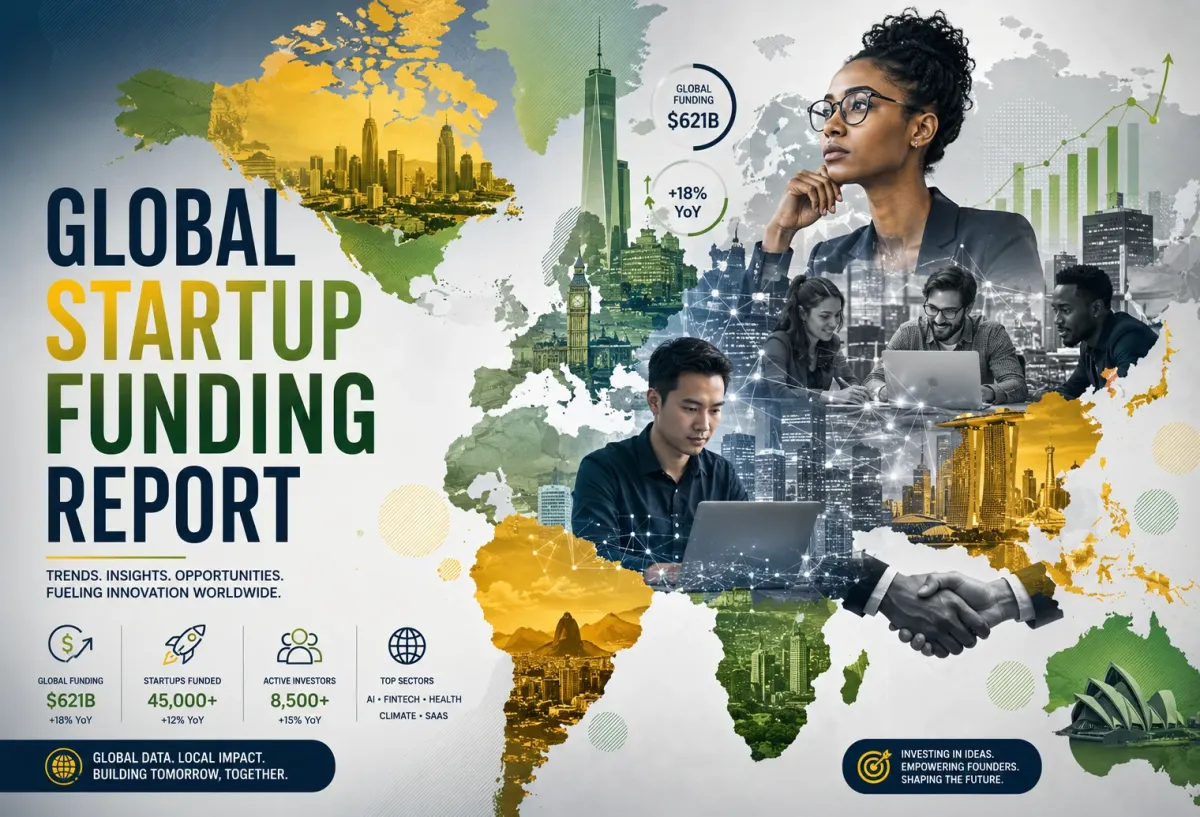
Here is the quick version. The money is still huge, it is just landing in fewer places. October is quieter than September, but “quieter” at this level would have been a record month three years ago.
The Highlights
Before the breakdown, these are the numbers worth remembering.
Q3 2026 global venture funding hit $159B, and AI took $102B of it, which is 64%.
A record 27 companies raised rounds of $1B or more in Q3, up from 16 in Q2 and 14 in Q1.
Funding through Q3 totals $679B, the highest for that stretch in any year on record.
October so far has seen about $5.8B across 32 AI rounds, against about $15.5B across 35 rounds in the first 19 days of September.
The biggest October checks went to a chip company, a developer tools company and an AI infrastructure platform.
Now let’s break down why those numbers matter, starting with the one that should make every founder pause.
One Category Is Eating the Whole Market
AI took nearly two thirds of every venture dollar in Q3. Half of the quarter’s capital also went to companies founded since 2022, which means the money is chasing newness as much as proven revenue.
That is a concentration story, not a growth story. When one category absorbs this much capital, everything else competes for what is left, and a correction in that one category would shake the whole market. This is exactly the kind of unchecked expansion we keep flagging here at TechStop.
So if AI is taking most of the money, the next question is what part of AI is getting paid.
October Is Cooler, and the Cooling Is Telling
Value Add VC tracked about $5.8B across 32 AI equity rounds from October 1 to 19. The same window in September saw roughly $15.5B across 35 rounds. Same deal count, far smaller checks.
A fair caveat here. These are tracker numbers, not the whole market, and October is still filling in. But the pattern is clear enough. Fewer giant September style rounds, and a steadier flow of large ones.
The largest of those October rounds show where investors actually want to stand, so let’s look at them.
The Money Is Moving Down the Stack
Look at who raised big. Tenstorrent closed a $1.5B Series E at a $6.2B valuation. TypeSafe AI raised $870M in a Series A at $7.5B. Modal Labs raised $750M in a Series D at $15.75B. In September, Crusoe raised $3.9B at roughly a $30.9B valuation and Positron raised $875M.
Chips, compute and the tooling that runs on top of them. Investors are funding the pipes, not just the apps built on the pipes.
That shift leads to one of the most interesting deals of the month, because it points at a bigger idea.
Owned Infrastructure Just Got a $445M Vote of Confidence
Oxide Computer raised a $445M Series D led by Eclipse after reaching profitability. Oxide sells hardware that companies run themselves instead of renting everything from a hyperscaler.
For anyone who has been told that renting every layer of the stack is the only sane option, this is a loud counterpoint. Investors are putting serious money behind owning the infrastructure, and doing it at a company that already turns a profit.
Infrastructure is not the only physical world bet getting funded, though.
Robotics and Defense Are No Longer Side Bets
Rhoda AI came out of stealth with a $450M Series A in robotics. Saronic, which builds autonomous vessels, landed a $1.75B Series D. Defense and autonomy have moved from niche to mainstream capital targets.
This matters for founders because it changes what a fundable story looks like. Software only pitches are competing against companies that build things you can touch.
All of this is happening in the US, so it is fair to ask whether the pattern holds elsewhere.
The Same Pattern Shows Up Globally
Germany’s Q3 deal count dropped to its lowest point of the year while individual rounds got bigger. In China, the quarter was the strongest recovery in three years by total volume, but the money went to about 1% of companies.
Fewer deals, bigger checks, tight concentration. It is the same shape in different countries.
Which raises the last and most practical question. If this much money is going in, how does it come back out?
The Exit Problem Nobody Wants to Say Out Loud
PitchBook describes a liquidity paradox. Exit value is at record levels, yet fund distributions are historically low and the IPO backlog keeps growing. Crunchbase also sees the 2026 IPO window narrowing, with companies like Oura among the nearest candidates. In India, 44 startups have filed or are preparing to list, targeting roughly INR 70,000 crore.
Paper valuations are climbing faster than cash is returning to investors. That gap is what to watch, because it decides how long the current pace can last.