.webp)
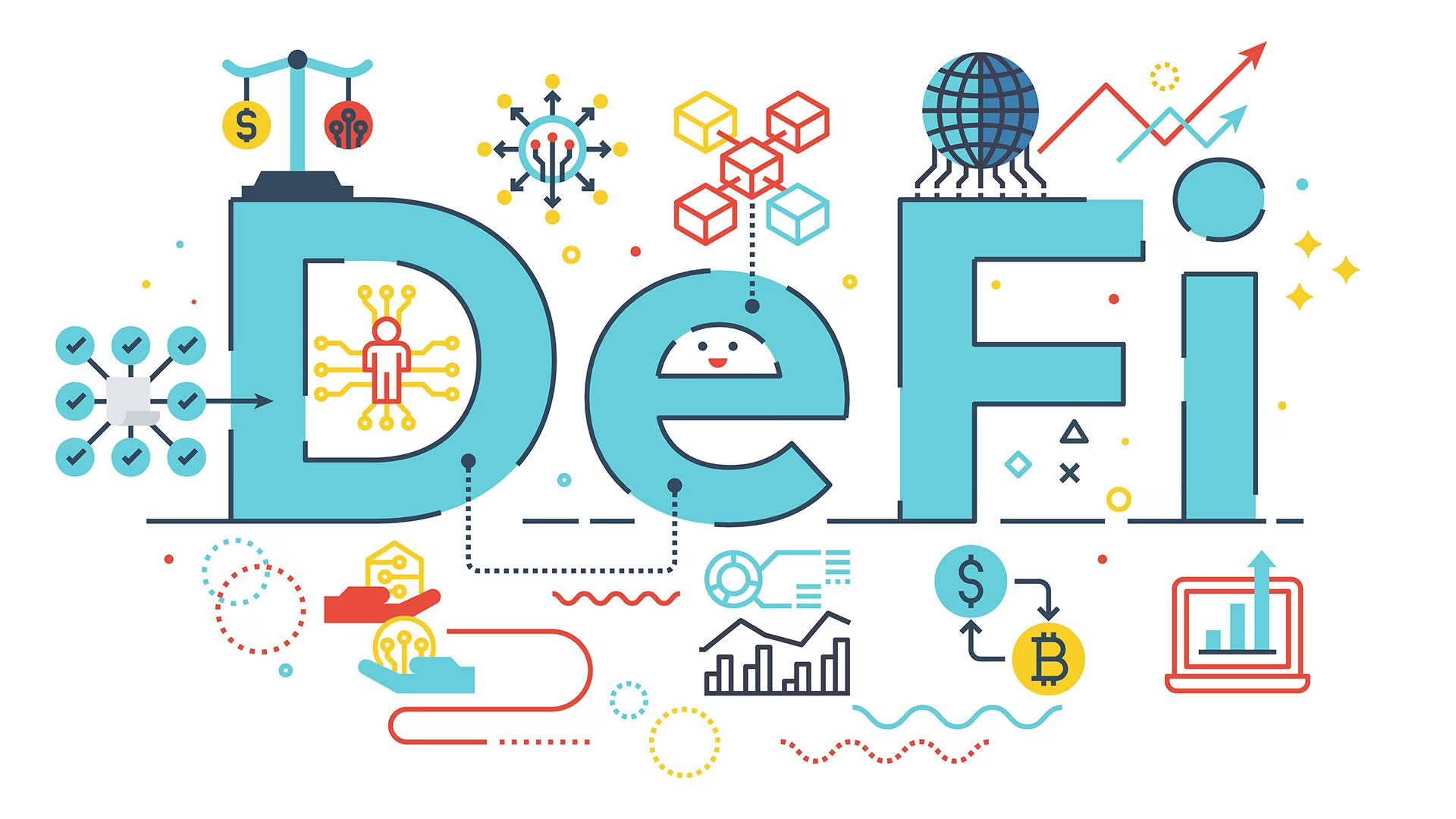
Decentralized Finance used to occupy a niche corner of the crypto conversation, associated mostly with speculative trading and retail experimentation. In 2026, that perception no longer holds. DeFi has matured into a functioning layer of financial infrastructure, and the institutions that once treated it with skepticism are now actively routing capital through it. Banks, brokerages, and asset managers are not simply observing the sector from the sidelines anymore, they are integrating it directly into their core products.
What Is Actually Happening Right Now
One of the clearest signals of this shift came when Robinhood selected the lending protocol Morpho to power its Earn product, bringing on chain yield to millions of retail brokerage users who have never interacted with a crypto wallet directly. This was not a crypto native platform attempting to convert new users, it was a mainstream brokerage quietly embedding decentralized lending infrastructure into a product its customers already trust.
Aave, the largest lending protocol in the industry, has expanded at a similar pace. The protocol launched a Global Dollar Hub designed for institutional stablecoin settlement, and its new lending market on the Monad blockchain surpassed 100 million dollars in deposits within just two days of launch. Aave's swap revenue alone recently crossed 1 million dollars, and together with the derivatives platform Hyperliquid, the two protocols generated close to 900 million dollars in revenue over recent months, figures that now place them in the same conversation as established fintech companies rather than experimental projects.
Uniswap, the leading decentralized exchange, surpassed 3 trillion dollars in cumulative trading volume on Ethereum, a milestone that positions it alongside long established trading venues in terms of scale. At the same time, BlackRock's tokenized fund BUIDL has been integrated directly into Uniswap's collateral and governance systems, a development analysts have described as one of the strongest signals yet that institutional asset managers view decentralized infrastructure as genuinely usable rather than purely experimental.
Real world asset tokenization offers another concrete example of this momentum. Solana's tokenized real world asset ecosystem reached an all time high of 3.4 billion dollars, and tokenized treasuries, commodities, and increasingly equities are being used as productive collateral inside lending protocols rather than sitting idle in traditional custody accounts.
Why Adoption Is Accelerating
Three distinct forces are converging to drive this shift. The first is regulatory clarity. Frameworks such as the GENIUS Act in the United States and the Markets in Crypto Assets Regulation in Europe have given stablecoin issuers and DeFi adjacent businesses a defined legal structure to operate within, removing much of the uncertainty that previously kept institutions on the sidelines.
The second is product maturity. Lending protocols, decentralized exchanges, and on chain derivatives platforms now offer execution quality that closely rivals centralized alternatives, supported by permissioned liquidity pools and compliance tooling built specifically for institutions that require verified access and audit trails.
The third is yield and operational efficiency. In an environment where traditional fixed income yield has remained unremarkable, DeFi offers transparent, programmable returns alongside faster settlement and materially lower overhead compared to legacy back office infrastructure.
A notable market signal reinforces this trend. In June 2026, Bitcoin declined 22 percent while major DeFi tokens fell by only about 4 percent, an unusual divergence that analysts at Bitwise characterized as a quiet repricing of the sector. This suggests the market may be beginning to value DeFi protocols based on underlying revenue and fundamentals rather than speculative momentum alone.
The Risks That Remain
Rapid adoption does not mean the sector has become risk free. Security breaches across bridges, protocols, and user accounts cost the industry close to 76 million dollars in June alone, following an even larger loss of approximately 82 million dollars in May. Oracle misconfigurations and execution safeguard failures continue to be the most common root causes, and this remains the primary reason institutions still describe themselves as cautious when it comes to deeper DeFi credit exposure, even as they embrace tokenization and stablecoin infrastructure with growing confidence.
Top 10 DeFi Development Companies Leading the Buildout
Behind every headline number sits a development team building and maintaining the protocol. Here is a breakdown of the ten companies currently shaping the direction of decentralized finance, along with an analysis of where each one stands.
1. Uniswap Labs
Uniswap Labs remains the dominant force in decentralized trading, having pioneered the automated market maker model that replaced traditional order books. With cumulative volume past 3 trillion dollars and a fee switch now routing a portion of swap fees toward buying back and burning its governance token, Uniswap has finally tied its token value to actual protocol usage. Its newer version introduces customizable liquidity logic through what the team calls hooks, alongside a dedicated Ethereum layer two network built specifically to lower trading costs. Analysis: Uniswap's scale advantage is difficult to challenge, and the shift toward real fee capture strengthens the long term investment case for its token, though its reliance on Ethereum gas markets and layer two fragmentation remains a structural dependency to watch.
2. Aave Labs
Aave has cemented itself as the largest lending protocol in DeFi, with total value locked regularly exceeding 26 billion dollars and daily revenue that has climbed sharply over the past year. Its expansion into a Global Dollar Hub for institutional stablecoin settlement and rapid deployment on new chains like Monad shows a team moving aggressively to capture institutional deposits before competitors do. Analysis: Aave's greatest strength is its liquidity depth and brand trust among institutions, but its growing footprint across multiple chains increases the surface area for smart contract and bridge related risk, which is worth monitoring closely.
3. Chainlink Labs
Chainlink functions as the oracle backbone of the entire DeFi ecosystem, supplying price feeds, randomness, and cross chain messaging that most major protocols rely on to function correctly. Recent developer activity rankings placed Chainlink at the top of the sector, reflecting sustained engineering investment rather than short term hype. Analysis: Chainlink's position is closer to critical infrastructure than a typical application, which makes it less exciting from a speculative standpoint but arguably more important from a systemic risk standpoint, since a failure here would ripple across the entire ecosystem.
4. Lido
Lido leads the liquid staking category by a wide margin, having secured tens of billions of dollars in total value locked and establishing itself as the primary gateway for yield bearing staked Ethereum. Its newest version introduces more customizable staking strategies aimed at institutional users with specific risk requirements. Analysis: Lido's scale gives it a durable moat in liquid staking, though its outsized share of staked Ethereum has repeatedly raised governance and centralization concerns that regulators and the Ethereum community continue to watch.
5. Sky, formerly MakerDAO
Sky, the rebranded evolution of MakerDAO, continues to anchor the DeFi stablecoin economy through its decentralized stablecoin and lending vault system. Reports project gross protocol revenue growth of roughly 81 percent year over year, driven by its Spark lending platform and expanding collateral options. Analysis: Sky's long operating history and proven stablecoin model give it credibility that newer entrants lack, and its pivot toward modular architecture positions it well for continued relevance, provided governance transitions remain smooth.
6. Morpho Labs
Morpho has emerged as one of the most important new lending infrastructure providers by building an optimizer layer on top of established protocols, matching lenders and borrowers directly for better rates while falling back to underlying liquidity pools when needed. Its selection by Robinhood to power a mainstream retail yield product marks a significant vote of confidence from traditional finance. Analysis: Morpho's peer to peer matching model gives it a genuine efficiency advantage over first generation lending pools, and the Robinhood partnership could make it one of the most widely used pieces of DeFi infrastructure by user count, even if most of those users never realize they are interacting with it.
7. Curve Finance
Curve remains the backbone of stablecoin liquidity in DeFi, using a specialized trading algorithm optimized for minimal slippage between similarly valued assets. Its native overcollateralized stablecoin and liquidation system have expanded Curve from a simple exchange into a broader credit protocol. Analysis: Curve's specialization gives it durable relevance since almost every other protocol depends on efficient stablecoin swaps at some point, though its governance structure built around locked tokens has periodically drawn criticism for concentrating voting power among long term holders.
8. Compound Labs
Compound was one of the earliest lending protocols to popularize supplying assets for interest and borrowing against collateral, and it remains a major player in the lending category. It continues to expand asset support and refine its interest rate models to stay competitive against newer entrants like Aave and Morpho. Analysis: Compound's first mover legacy and brand recognition remain valuable, but the protocol faces genuine competitive pressure from more capital efficient designs, and its growth has been more measured compared to faster moving rivals.
9. EigenLayer
EigenLayer introduced the restaking category to Ethereum, allowing staked assets to simultaneously secure additional networks and earn layered yield. This has positioned it as core infrastructure for a new generation of decentralized services that need to bootstrap security without building their own validator networks from scratch. Analysis: EigenLayer's restaking model is genuinely novel and has attracted significant capital quickly, but it also introduces new forms of systemic risk since the same staked capital is now securing multiple systems at once, a design that has not yet been tested through a full market cycle.
10. Hyperliquid
Hyperliquid has grown rapidly as a high performance decentralized derivatives exchange, generating revenue on par with established lending protocols and recently securing a license to launch a regulated equity index perpetual futures contract. Its rise reflects growing institutional appetite for on chain derivatives that can match centralized exchange execution quality. Analysis: Hyperliquid's technical performance and revenue growth are impressive for a relatively young platform, and its move into licensed derivatives products suggests an ambition to compete directly with centralized exchanges rather than remain a crypto native niche product, though this also brings it under closer regulatory scrutiny.
What Happened Over The Past Month
Several concrete developments defined the DeFi landscape through June and early July. Robinhood committed to Morpho as the engine behind its retail yield product, expanding decentralized lending access to a mainstream user base. Aave launched its Global Dollar Hub and surpassed 100 million dollars in deposits on its new Monad market within 48 hours of going live. Uniswap crossed the 3 trillion dollar mark in cumulative trading volume on Ethereum, and Solana's tokenized asset ecosystem reached a fresh all time high of 3.4 billion dollars.
On the regulatory front, the United Kingdom's Financial Conduct Authority finalized its crypto regulatory framework, introducing mandatory licensing requirements for trading platforms, stablecoin issuers, and custodians ahead of a formal start date in late 2027, giving the industry a multi year runway to prepare for compliance. On the risk side, the sector recorded close to 76 million dollars in losses from exploits during June, a clear reminder that infrastructure growth and security maturity are not advancing at the same pace.
Where DeFi Is Headed Next
Industry forecasts for the remainder of 2026 point toward continued institutional inflows into lending markets and tokenized treasuries, with total value locked across DeFi projected to climb toward the 200 billion dollar range. Analysts widely expect the Securities and Exchange Commission to move toward formal rulemaking that could eventually allow tokenized securities to trade directly on public DeFi infrastructure rather than through wrapped intermediary structures, a shift that would meaningfully expand what institutions are legally permitted to do on chain.
Looking further ahead, expect a growing number of banks to experiment with permissioned liquidity pools, additional brokerages to quietly integrate DeFi yield in the way Robinhood already has, and continued scrutiny of protocol level security as the amount of institutional capital at stake keeps rising. Analysts also anticipate that yield bearing stablecoins will become a core collateral type across the ecosystem, and that real world asset tokenization will continue expanding well beyond treasuries into commodities, credit instruments, and tokenized equities as regulatory frameworks mature.
Taken together, the pattern is clear. DeFi is no longer defined primarily by speculation or short term price action. It is increasingly defined by revenue generating protocols, institutional integration, and infrastructure built to support real financial activity at scale, positioning the sector for a more durable and structurally significant role in global finance going forward.