.webp)
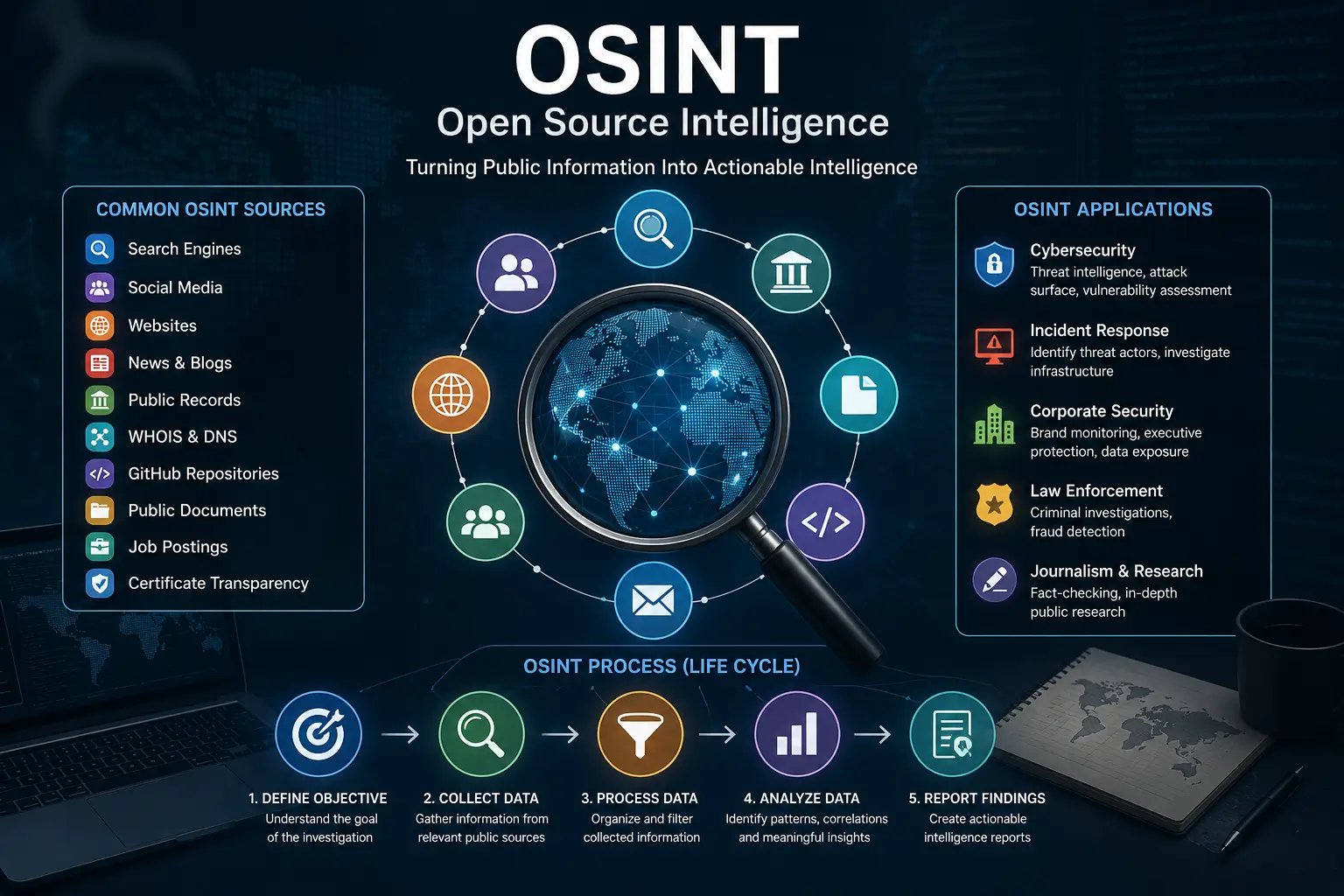
In today's digital world, information is one of the most valuable assets. Every day, individuals and organizations generate vast amounts of publicly accessible data through websites, social media platforms, public records, online forums, and technical databases. The process of collecting, analyzing, and using this publicly available information to produce meaningful intelligence is known as Open Source Intelligence (OSINT).
Contrary to popular belief, OSINT is not about hacking or illegally accessing systems. It is a legal and ethical practice that focuses on gathering information from open sources to support decision-making, cybersecurity investigations, threat intelligence, and risk assessments. Because of its effectiveness, OSINT has become an essential skill for cybersecurity professionals, digital investigators, journalists, law enforcement agencies, and businesses.
One of the primary reasons OSINT is so important is that organizations often expose more information than they realize. Company websites, employee profiles on professional networking platforms, public GitHub repositories, DNS records, job advertisements, and even PDF documents can reveal valuable insights about an organization's infrastructure and operations. Cybercriminals frequently use this information to identify potential targets. Likewise, security professionals use OSINT to discover these exposures before attackers can exploit them.
OSINT data comes from a wide range of publicly available sources. Search engines provide access to indexed web content, while social media platforms offer information about individuals, organizations, and ongoing events. Government databases contain public records that can support investigations. WHOIS and DNS records reveal domain registration and network information, while Certificate Transparency logs help identify digital certificates issued for internet-facing services. Public repositories, technical forums, and company websites also contribute valuable intelligence that can be analyzed to understand an organization's digital footprint.
OSINT in Cybersecurity
In cybersecurity, OSINT plays a critical role in strengthening security and reducing risk. Security analysts use OSINT to identify exposed assets, monitor an organization's external attack surface, detect leaked credentials, and gather threat intelligence. During penetration testing and red team engagements, OSINT helps professionals understand publicly available information about the target environment before conducting authorized security assessments. This enables organizations to identify weaknesses and improve their defensive posture proactively.
Beyond cybersecurity, OSINT has applications in many other fields. Law enforcement agencies use it to investigate criminal activities, identify suspects, and analyze online behavior. Journalists rely on OSINT to verify information, investigate public events, and fact-check sources. Businesses use it for brand monitoring, competitor analysis, executive protection, and third-party risk management. Researchers also depend on OSINT to collect reliable data from publicly available resources for academic and professional studies.
Several specialized tools have made OSINT investigations more efficient and effective. Popular tools include Maltego for relationship mapping, SpiderFoot for automated reconnaissance, theHarvester for collecting email addresses and domain information, Shodan for discovering internet-connected devices, Amass for subdomain enumeration, Recon-ng for reconnaissance automation, and Censys for internet infrastructure analysis. Each tool serves a unique purpose, allowing investigators to gather, organize, and analyze data more efficiently.
The OSINT Process and Its Challenges
An effective OSINT investigation follows a structured methodology. It begins by clearly defining the objective of the investigation, whether it is identifying exposed assets, analyzing a domain, or investigating a potential threat actor. The next step involves identifying reliable public sources and collecting relevant information. Once the data has been gathered, analysts verify its accuracy by cross-checking multiple independent sources. The verified information is then analyzed to identify patterns, relationships, and potential risks before being documented in a comprehensive report that supports informed decision-making.
While OSINT offers significant benefits, it also presents challenges. The internet contains an overwhelming amount of information, making it difficult to distinguish accurate data from misinformation or outdated content. Fake social media profiles, manipulated information, and incomplete datasets can easily mislead investigators if proper verification techniques are not applied. For this reason, successful OSINT investigations require critical thinking, analytical skills, and a commitment to validating information before drawing conclusions.
Ethics and legality are fundamental principles of OSINT. Professionals should only collect information that is publicly accessible and avoid unauthorized access to systems or private data. Respecting privacy laws, maintaining transparency, and using information responsibly are essential to ensuring that OSINT remains a legitimate and valuable investigative discipline.
As technology continues to evolve, Artificial Intelligence and automation are transforming the field of OSINT. AI-powered tools can process massive amounts of data, identify hidden relationships, and accelerate investigations more efficiently than traditional manual methods. Despite these advancements, human judgment remains essential for verifying information, interpreting findings, and making informed decisions.
Conclusion
Open Source Intelligence is far more than a simple internet search. It is a structured and disciplined process that transforms publicly available information into actionable intelligence. Whether used for cybersecurity, digital investigations, business intelligence, or research, OSINT enables professionals to understand their environment, identify risks, and make better decisions. As the digital landscape continues to expand, mastering OSINT has become an essential skill for anyone pursuing a career in cybersecurity or information security.