.webp)
The Real Problem Is Not Hackers, It Is Leftovers
Here is the uncomfortable truth about cybersecurity in 2026. Most serious incidents are not movie style hacks. Someone gets hold of a login that already worked, and that login had far more power than it needed, for far longer than anyone intended.
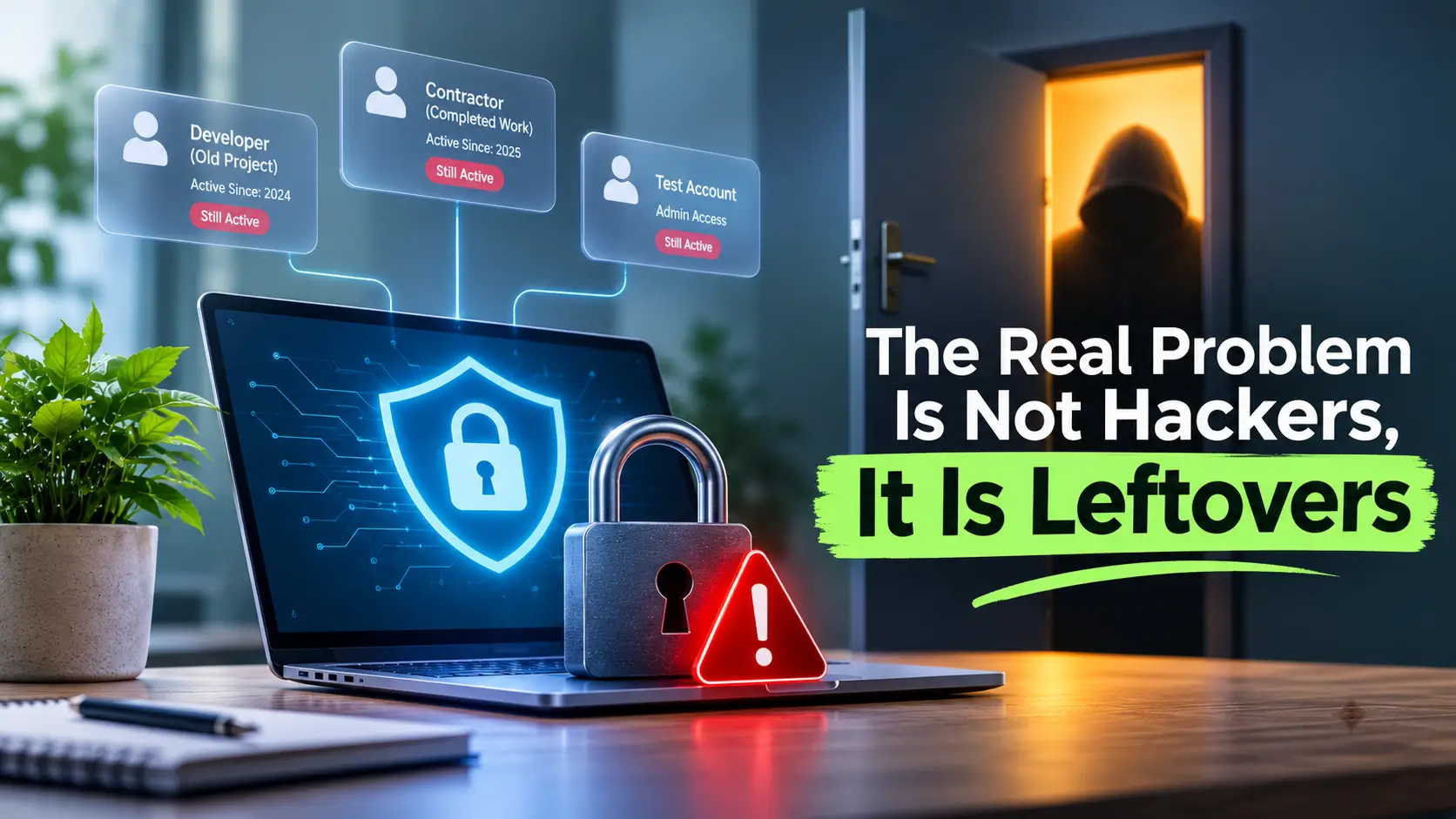
Think about a developer who needed database access for a two day migration. The migration finished months ago. The access did not go anywhere. A contractor finished a project last spring and the account is still active. A service account was created for a test and now sits in production with admin rights, because nobody wants to be the person who breaks something by deleting it.
These leftovers are what security people call standing privileges. They are permissions that sit there around the clock whether anyone is using them or not. Every one of them is a door that stays unlocked after the guest has left. An attacker does not need to break in. They just need to find the door.
Privacy Is the Same Problem Wearing a Different Jacket
Cybersecurity and privacy get discussed as two topics, but they share one root. Both ask the same question. Who can touch this data, and why do they still have access?
Every extra person, system, or token that can read customer data is another place that data can leak from. Privacy law, customer trust, and basic security all point in the same direction. Collect less, share with fewer people, and keep access for a shorter time. A company that cannot answer “who can see this right now” in under a minute does not have a privacy program. It has a hope.
The Shift Companies Are Making in Real Time
The most important change in security architecture right now is a simple idea. Access should be an event, not a state.
The industry names for it are just in time access and zero standing privilege. The idea is easy to explain with a hotel. A house key works every day until somebody changes the lock. A hotel key card works for your room, for your dates, and then it quietly stops working at checkout. Nobody has to remember to collect it. The expiry is built in.
That is exactly where modern access control is heading. Instead of giving a person or a system permanent power, the company grants the specific permission needed for the specific task, for a limited window. When the window closes, the access disappears automatically. No cleanup ticket. No reminder email. No human memory required.
A typical flow looks like this.
An engineer needs to fix a production issue. They request access to one system for one hour and state the reason. A policy engine checks who they are, what device they are on, and whether the request makes sense. If approved, a temporary credential is created. The work gets done, the session is logged, and the credential dies on schedule. If the same engineer’s laptop is compromised the next day, the attacker finds nothing worth stealing, because there was never a permanent key to steal.
The logic is blunt and effective. Credentials that always work are credentials worth stealing. Credentials that exist for forty minutes are far less interesting.
How Cloud Platforms Made Temporary Access the Default
The big cloud providers pushed this idea into the mainstream, and the pattern is worth understanding even if you never touch their dashboards.
Instead of handing a server a permanent password, the platform lets that server take on a role and receive credentials that rotate and expire automatically. The server never stores a secret that lives forever, so there is nothing sitting in a config file or an old backup waiting to be found. The same approach now applies to human users, who sign in through a central identity system and receive short lived access rather than keeping personal long term keys.
Two companion habits come with it. Permissions start narrow and get audited, so unused ones are found and removed. And sign in moves toward phishing resistant methods such as passkeys and hardware security keys, because a text message code can still be talked out of a tired employee.
What Large Ecommerce Platforms Teach Everyone
Ecommerce is a brutal testing ground for security, because trust is the entire product. Shoppers hand over payment details and addresses to strangers on the internet, and sellers hand over identity documents to get listed. The platforms that survive build trust in layers rather than relying on one wall.
Verify first. Serious marketplaces check the identity of new sellers before they can sell, using government issued documents and technology that detects forged ones. Trust is earned at the door, not assumed.
Keep watching afterward. Verification at signup is not enough, so systems continue to monitor accounts for unusual changes in details, behavior, and links to previously flagged bad actors. A seller who looked clean in January can look very different in June.
Scan at machine scale. Automated models review enormous volumes of listing changes and reviews every day, looking for counterfeits and fake reviews. Human investigators step in where the models flag something, which is the right split between automation and oversight.
Defend against impersonation outside your own walls. Brands that shoppers trust get imitated constantly, with fake delivery alerts, fake account suspension notices, and fake invoices designed to rush people into handing over card details. The strongest defenses are verified email technology, clear public rules such as never asking for passwords or payment details over email or phone, and fast takedown of lookalikes.
The common thread is the same as expiring access. No single check is trusted forever. Every layer assumes another one might fail.
Zero Standing Privilege Is Not a Magic Button
Now for the part most vendor blogs skip. Just in time access can be done badly, and a badly done version feels secure while leaving the same holes.
Some teams grant temporary access but make people eligible to activate admin rights whenever they like, which just moves the standing privilege one step back. Some teams build an emergency bypass for when the access system is down, and that bypass quietly becomes the new permanent backdoor. Some approval queues get so slow that people start asking for broad, long windows to avoid asking again, which defeats the whole point.
A temporary grant is not the same thing as zero standing privilege. The real test is simple. If an attacker steals an identity today, how much power do they actually get right now? If the honest answer is “a lot, they just have to click activate”, you have a nicer looking version of the old problem.
Where AI Agents Make This Urgent
There is a newer reason to care. Companies are wiring AI agents into email, databases, code repositories, and payment tools. Each agent needs credentials, and agents do not get tired, forgetful, or suspicious. If an agent holds permanent broad access and gets tricked by a malicious prompt, it will use that access at machine speed.
This is where human oversight matters, and it is why unchecked AI expansion deserves skepticism. Short lived, narrowly scoped access for automated systems, with a person approving anything sensitive, keeps a mistake small. An agent that can only touch one folder for ten minutes cannot empty the company vault, no matter how clever the attacker’s instructions are.
The Owned Infrastructure Angle
One more point worth making. When you run your own infrastructure, you control the access model end to end. You decide how long credentials live, where logs are stored, and who can see what. When every function sits inside a stack of third party tools, your access story is only as good as the weakest vendor connection and the broadest token you handed out to make an integration work.
That does not mean avoid all outside services. It means know every connection, give each one the least power that works, and make sure you can revoke it in minutes, not weeks.
What You Can Do This Week
You do not need an enterprise budget to start. Here is a practical order of attack.
First, list every account with admin or elevated rights, including service accounts and old contractor logins. You will be surprised by the length of the list.
Second, remove anything that has not been used recently. If something breaks, you learn what it was for, and you can grant it back properly.
Third, replace long lived keys and shared passwords with short lived credentials wherever your platform supports them.
Fourth, turn on phishing resistant sign in, such as passkeys or hardware keys, for every administrator first.
Fifth, require a written reason and an automatic expiry for any elevated access. Even a simple ticket with an end time beats permanent rights.
Sixth, log everything that touches customer data and review it on a schedule. Access you never look at is access you cannot defend.
Finally, give your AI tools and automations the same treatment as new employees. Narrow scope, short leash, and a human in the loop for anything that moves money or deletes data.
The Takeaway
In 2026, the strongest security teams are not the ones with the tallest walls. They are the ones who assume somebody will eventually get a valid login, and design things so that login is worth almost nothing. Access that expires, permissions that are narrow, and trust that gets checked again and again. That is how you protect customer privacy without slowing your business to a crawl.
Give people the key for the job, then take the key back. Do it automatically, and do it every time.