.webp)
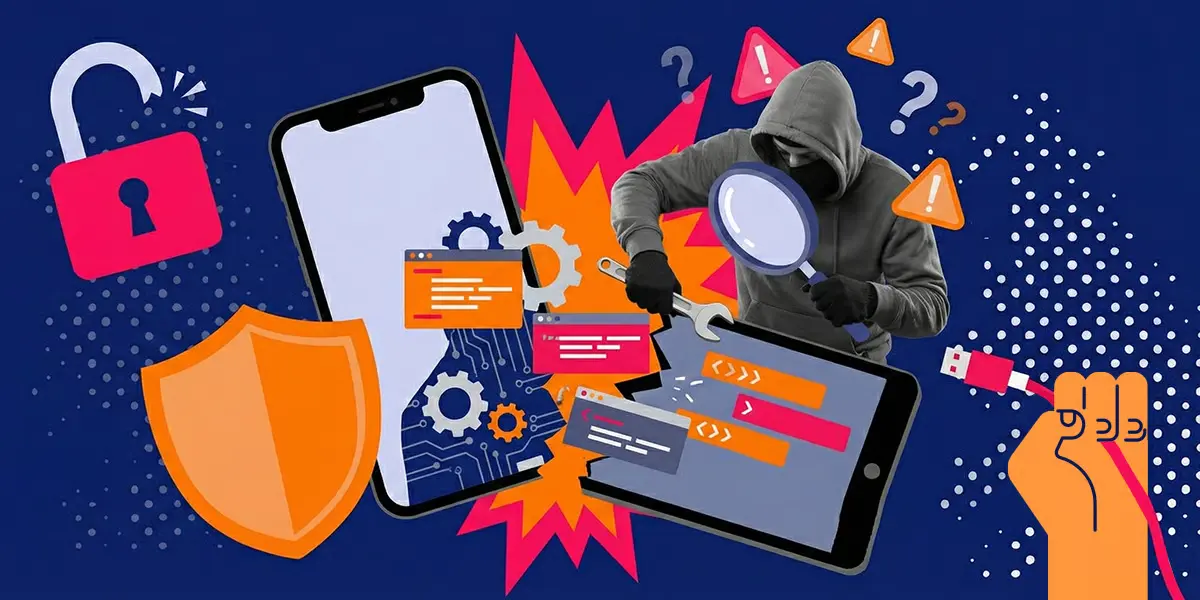
The uncomfortable truth about mobile security: when you publish an app, you hand every user a copy of your code and let them run it on hardware they fully control. Not a demo. Not a summary. The actual application, sitting on a device where the person holding it can inspect, modify, and instrument everything.
That single fact explains most mobile breaches. Teams treat the app like a locked vault, put keys and business logic inside, and act surprised when someone opens it. Think of it like mailing your house key to every customer inside a box with a lock on it. The lock might slow someone down. It does not change who holds the box.
This article covers how reverse engineering really works, why secrets embedded in a client never stay secret, and which defenses earn their place in your budget.
How Reverse Engineering Actually Works
You do not need elite skills to pull an app apart. The tooling is mature, free or cheap, and well documented.
Getting the app
On Android, an app package is essentially an archive. Anyone can download it from a store, a mirror, or their own device. On iOS, apps are distributed in an encrypted form, but the protection is removed at runtime, and researchers routinely work with decrypted copies from devices they control.
Reading the code
Android apps compile to bytecode that decompilers convert back into readable Java or Kotlin, often with class names, method names, and string values intact. iOS apps compile to native machine code, which is harder to read, but disassemblers and metadata extraction still reveal class structures, function names, and every string literal in the binary.
Cross platform frameworks change the picture, but not in your favor. A React Native app ships its JavaScript bundle. A Flutter app ships compiled Dart with recognizable structure. A Unity game ships assemblies that decompile cleanly. Framework choice changes which tools an attacker picks, not whether the attack works.
Watching it run
Static reading is only half of it. Attackers also use instrumentation frameworks to hook functions while the app runs, print arguments, change return values, and skip checks entirely. They put a proxy between the app and your server to read every request and response. If your security depends on the app behaving honestly on the user's device, instrumentation ends that assumption in minutes.
Repackaging
Once someone understands the app, they can modify it, re sign it, and redistribute it. That is how you get cloned apps, cracked premium features, ad fraud versions, and malware wrapped in your brand.
Why Client Side Secrets Never Stay Secret
This is the mistake we see most often in agency and startup code. A developer needs to call a payment API, a mapping service, an AI provider, or a cloud storage bucket, so the key goes in the app. Sometimes in a config file. Sometimes in an environment variable at build time, which feels safe but is not, because build time values get compiled into the shipped package.
Once a secret is in the binary, it is extractable. Splitting it into pieces, encoding it, or hiding it behind a function call only adds a few minutes to the attacker's day. Anything the app needs to use, the app must be able to reconstruct, and anything the app can reconstruct, a debugger can watch it reconstruct.
The rule is simple. If a value would hurt you when published on a public forum, it does not belong in the client. That includes:
Private API keys for paid services
Database credentials and cloud admin keys
Signing secrets for tokens
AI provider keys that bill per request
Any hidden endpoint you rely on staying undiscovered
The fix is architectural, not cosmetic. Put those calls behind your own backend. The app authenticates the user, your server holds the real credentials, applies rules, and talks to the third party. You keep control on infrastructure you own, and a leaked app reveals nothing that matters.
For keys that must live in the client, such as public identifiers for a maps or analytics service, restrict them at the provider level by bundle identifier, signing certificate, or allowed domains, and set usage quotas so abuse hits a ceiling.
What Obfuscation Does and Does Not Do
Obfuscation renames classes and methods into meaningless strings, removes unused code, and can add tricks like encrypted strings and scrambled control flow. On Android, shrinking and renaming tools ship with the standard build chain and should be on for every release. Commercial tools go deeper.
What it buys you: more time and effort for the attacker. That has real value against casual copying and automated scanners, and for protecting proprietary algorithms.
What it does not buy you: secrecy. A determined attacker is not stopped by obfuscation, they are billed extra hours by it. Treat it as friction, not a wall. And never let it convince you that a secret is safe. Obfuscated garbage still executes, and execution can be observed.
Runtime Protection: Useful, With Limits
Runtime application self protection adds checks inside the app: detecting rooted or jailbroken devices, debuggers, hooking frameworks, emulators, and tampered packages. When something looks wrong, the app can degrade features, log the event, or shut down.
These checks help, and you should use them where the risk justifies it, such as banking, payments, health data, and high value games. But understand the limits:
The checks run on the attacker's device, so they can be found and patched out.
Detection is an arms race. Every public bypass forces an update.
False positives lock out legitimate users, especially those with custom devices or accessibility tools.
That last point is where human oversight matters. Do not let an automated signal silently ban paying customers. Log the events, review patterns, and decide policy with a person in the loop. A protection layer that no one monitors will eventually punish the wrong people.
What Actually Moves the Needle
The defenses that hold up share one property: they do not rely on the client telling the truth.
Server side enforcement of everything that matters
Every permission check, price calculation, entitlement, and rate limit must be enforced on the server. If a modified app can unlock a feature by flipping a flag locally, the design is broken, no matter how well the code is obfuscated. Assume every request is hostile and validate it as if the client were written by an attacker.
Short lived, per user credentials
Replace long lived shared keys with tokens tied to an authenticated user, scoped narrowly, and expiring quickly. When one leaks, the blast radius is one session, not your whole platform.
App and device attestation, verified on your backend
Platform attestation services let your server ask whether a request comes from a genuine, unmodified copy of your app on a genuine device. The important part is where the verdict is checked. Verify it on your own server before trusting the request. It is not perfect, but it raises the cost of running modified clients at scale from trivial to expensive.
Certificate pinning as a speed bump
Pinning makes casual traffic inspection harder by refusing certificates you did not expect. Motivated attackers bypass it with instrumentation, so treat it as one layer, and plan for key rotation so a certificate change does not brick your app.
Monitoring and abuse detection
Watch for impossible usage patterns, credential stuffing, and traffic that looks scripted. Reverse engineering is often the first step in a larger abuse campaign. The server is where you see the second step.
A Practical Checklist for 2026
Before your next release, run through this:
Search your built package for secrets. If you can find a key with basic string searching, so can everyone else.
Move third party API calls behind your own backend.
Turn on code shrinking and renaming for release builds.
Confirm that every sensitive action is authorized server side.
Use short lived tokens and rotate anything that has ever shipped in a client.
Add attestation for high risk flows and verify it on your server.
Test your own app the way an attacker would, or hire someone who will.
Measure your app against the OWASP Mobile Application Security Verification Standard so your target is a recognized benchmark, not a guess.
The Mindset That Fixes This
Stop asking how to hide things in the app. Start asking what happens when everything in the app is public. Design so the answer is "nothing important." Keep secrets and decisions on infrastructure you own and can monitor, use the client only for presentation and user input, and treat protection layers as friction that buys time, not guarantees.
Attackers will always get the binary. The goal is to make sure the binary is worth nothing on its own.