.webp)
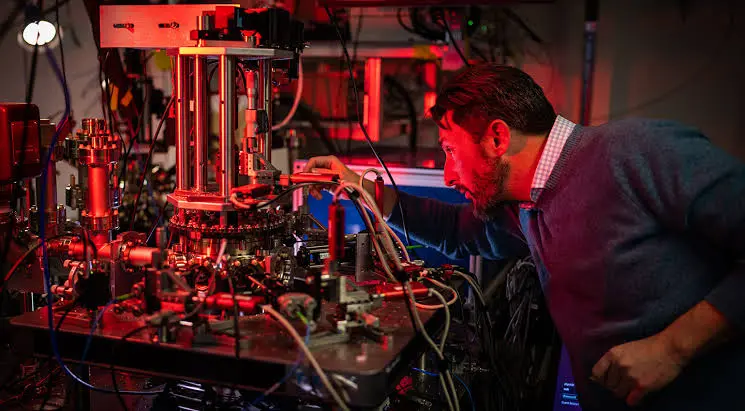
Nobody sent out a press release announcing it, but somewhere in the last week of August, quantum computing quietly changed categories. It stopped behaving like a research bet and started behaving like a strategic resource, the kind of thing nations subsidize, defense agencies stockpile talent for, and industrial giants buy their way into rather than build from scratch.
You can tell because of who showed up to the table. Not just physicists. Governors. A federal agency that normally worries about identity badges. A defense hub in Finland. The Canadian government, writing a check with more zeroes than most Series B rounds. When that many non-technical actors start moving money and policy at once, it usually means the underlying technology has crossed some invisible line from interesting to unavoidable.
The Money Stopped Being Venture Money
Quantum startups have always raised money. What changed is who is writing the checks.
Canada committed roughly CAD 195 million toward Xanadu's "Inception" facility, a 158,000 square foot photonics manufacturing plant in Toronto that is part of an 893 million dollar buildout. That is not an investor betting on a return. That is a government building a factory it considers a national asset, the same instinct behind semiconductor fabs and battery plants.
The United States moved in similar fashion, just spread across more agencies. New Mexico is now offering seven figure grants to quantum companies willing to relocate project work into the state, tied directly to a DARPA benchmarking initiative and an NSA-linked program. California put nearly ten million dollars behind a Southern California quantum ecosystem anchored by UCLA, explicitly framed around job creation. The National Science Foundation pushed 290 million dollars across eight research institutes in a single announcement. None of this reads like early-stage funding. It reads like infrastructure policy.
Even the retail side of the market is adjusting. A partnership between iAccess Partners and QAI Ventures dropped the minimum ticket for early-stage quantum venture exposure to 25,000 dollars, using bankable instruments to open a door that used to require institutional-scale capital. When access gets democratized like that, it is usually a signal that the people closest to the deal flow expect the value to be realized soon, not decades out.
Governments Are Racing to Own the Hardware, Not Just Fund It
The clearest evidence that quantum has become a sovereignty issue is how many countries spent the week announcing that they intend to build and operate their own systems rather than rent time on someone else's.
Japan brought its first full-stack neutral-atom quantum computer online. It is called Shunkai, built with Hitachi and Infleqtion, starting at 50 qubits with a stated ambition of reaching 10,000 by 2031, and it runs at room temperature. India approved its first dedicated Quantum and AI university campus, backed by roughly 730 crore rupees in government funding, explicitly tied to national missions in quantum, AI, and semiconductors. Sweden published a national quantum strategy running through 2036 that pairs commercialization goals with a mandate to adopt post-quantum cryptography across the country's institutions.
Even Saudi Arabia got a seat at the table this week, through a joint venture between Pasqal and Eleven Ventures aimed at deploying neutral-atom systems on-premises across the MENA region as part of Vision 2030. That detail matters: on-premises, not cloud-accessed. Countries do not appear to want to depend on someone else's quantum cloud any more than they want to depend on someone else's power grid.
The Security Story Moved From Warning to Deployment
For years, post-quantum cryptography has lived mostly in white papers and roadmap slides. This week it started showing up in procurement documents and product launches instead.
The US General Services Administration and Treasury Department both launched formal post-quantum initiatives, driven by an executive order and an OMB memorandum, covering everything from federal identity systems to a new Quantum-Readiness Task Force for the financial sector. India's C-DOT unveiled fourteen indigenous quantum-secure products on its anniversary, including key distribution hardware built with 6G networks in mind. A UK firm called Sitehop launched a unit specifically built to retrofit aging Five Eyes defense networks with post-quantum encryption without replacing the underlying hardware, a direct answer to the "harvest now, decrypt later" threat that has been the industry's boogeyman for years.
On the private sector side, SEALSQ's subsidiary IC'Alps is pushing toward a functional prototype of a quantum-resistant custom chip, CypherGenics launched an authentication platform claiming a hundred-times speed advantage over traditional public key infrastructure, and a company called Postquant Labs shipped a cross-chain crypto swap protocol built specifically to remove the bridge vulnerabilities that quantum decryption is expected to exploit first.
None of these are proof that a code-breaking quantum computer is imminent. What they prove is that enough serious institutions now believe the risk is real enough to spend real budget on it today, rather than filing it under future problems.
The Big Players Are Buying Their Way Into Physics They Don't Have
IBM closed its acquisition of HRL Laboratories this week, picking up silicon spin qubit expertise and quantum sensing capability that IBM did not previously have in-house. The deal keeps Boeing and General Motors involved as strategic partners, a detail that says as much as the acquisition itself. IBM is not just buying a lab. It is buying a second hardware bet, running silicon quantum dots alongside its existing superconducting circuit approach, because nobody in this industry is confident enough yet to go all in on one physical architecture.
That hedge shows up everywhere once you start looking for it. Diraq opened a new engineering hub in Santa Monica to push its silicon spin-qubit roadmap toward commercial CMOS foundries. Rigetti split its organization in two, pulling systems delivery away from core research so its processor team can chase 99.5 percent two-qubit gate fidelity without also worrying about manufacturing logistics. Pasqal finished a SPAC merger and started trading on Nasdaq with roughly 360 million dollars in the bank, earmarked for scaling its neutral-atom fleet.
Nobody has settled on the winning architecture. Superconducting, neutral-atom, silicon spin, photonic, they are all still in play, and the companies with the deepest pockets are increasingly choosing to fund more than one horse rather than pick a favorite.
Why This Should Matter to Anyone Running a Business, Not Just a Physics Lab
It is tempting to read all of this as a story for hardware people. It is not. The pattern that matters for founders and technology leaders is simpler: infrastructure decisions that used to be optional are becoming mandatory faster than most roadmaps account for.
Post-quantum cryptography is the clearest example. Federal agencies, financial regulators, and defense networks are not treating PQC migration as a someday project anymore, they are treating it as a compliance deadline with a task force attached. Any business holding long-lived sensitive data, the kind an attacker could harvest today and decrypt once quantum hardware catches up, is on the same clock whether it has noticed or not.
There is also a quieter lesson in how much of this week's activity was about owning infrastructure rather than renting it. Governments building their own fabs. Countries insisting on on-premises deployment instead of cloud access. IBM buying hardware capability instead of licensing it. That instinct, control the stack you actually depend on, is the same one that should guide smaller companies deciding whether to build core systems in-house or hand them to a third party that may not still exist, or may not still be trustworthy, by the time the bill comes due.
Quantum computing is still years away from being something most businesses touch directly. The infrastructure being built around it, the security requirements, the sovereignty instincts, the hedged architecture bets, is not years away. It is happening now, and it is setting the terms for how seriously the next decade of technology infrastructure gets built.