.webp)
Google & SpaceX Are Planning to Put AI Data Centers in Space
The AI infrastructure race just left the atmosphere. Google and SpaceX are in advanced discussions to launch data centers into orbit — a move that could fundamentally reshape how artificial intelligence is powered, cooled, and scaled for the next decade.
The talks, first reported by The Wall Street Journal, signal just how serious the compute crunch has become on Earth. Land is running out. Power grids are maxed. And tech giants are now looking up.
What Is Google's Project Suncatcher?
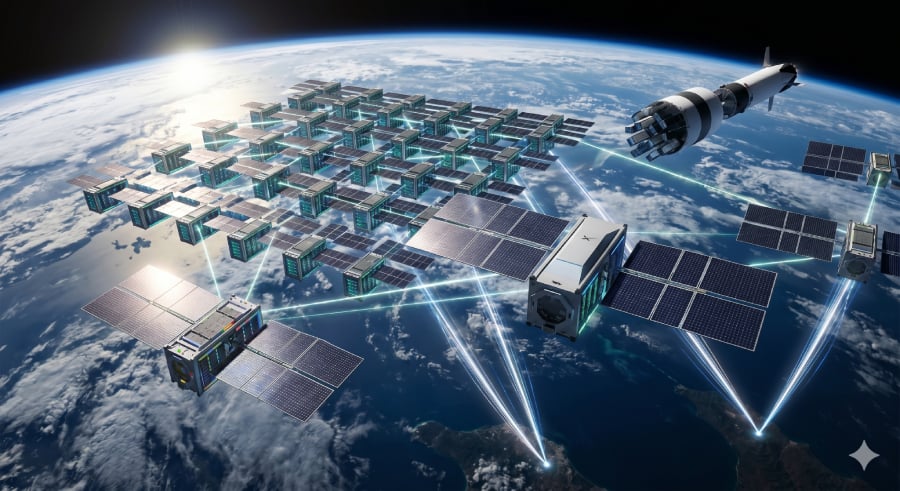
At the center of these discussions is Project Suncatcher, a Google initiative announced in late 2025 that aims to place AI computing hardware into orbit by 2027. The plan involves launching solar-powered satellites equipped with Google's own Tensor Processing Units (TPUs) — the same AI chips that power Google's machine learning workloads on the ground.
Google CEO Sundar Pichai has described the initial prototypes as "tiny racks of machines" — experimental test hardware that would validate whether large-scale AI computing can realistically operate in space. If the tests succeed, the implications for the entire AI industry would be enormous.
SpaceX is emerging as the frontrunner launch partner for Project Suncatcher, though Google is also reportedly speaking with other rocket companies.
Why Are They Doing This? The AI Infrastructure Problem
To understand why orbital data centers are suddenly a serious conversation, you need to understand the scale of AI's energy problem.
The explosion of generative AI has turned data centers into some of the most energy-hungry facilities on the planet. Meta, Amazon, Microsoft, and Alphabet have collectively signaled roughly $725 billion in capital expenditure for 2026 — almost entirely for data centers, custom chips, and GPUs. That's a 75% jump over last year.
On the ground, expansion is hitting walls:
Power grids in key regions like Northern Virginia, Singapore, and the Nordics are at capacity
Land use and zoning battles are slowing or blocking new builds
Water cooling demands are drawing environmental criticism
Local opposition (NIMBYism) is a growing political problem for hyperscalers
Orbital data centers sidestep most of these obstacles. Satellites in the right orbital paths can access near-continuous solar energy, cool themselves by radiating heat directly into space, and require zero land or grid infrastructure on Earth.
SpaceX's Big Bet — and Its Upcoming IPO
SpaceX isn't approaching this deal purely as a launch vendor. The company is actively pitching orbital AI infrastructure as a core business — and the timing is deliberate.
SpaceX is preparing for what could be the largest IPO in history, targeting a valuation between $1.75 trillion and $2 trillion in mid-2026. Orbital data centers are central to the growth story being sold to investors: a future in which SpaceX is not just a rocket company but the backbone of global AI compute.
The company has already filed for authorization to launch up to one million satellites to support its orbital ambitions. And it recently signed a landmark deal with Anthropic — the AI safety company behind Claude — giving Anthropic access to over 220,000 Nvidia GPUs and 300 megawatts of compute at SpaceX's Colossus 1 data center in Memphis, Tennessee, which came via SpaceX's February 2026 merger with xAI.
A confirmed Google partnership would significantly strengthen SpaceX's IPO narrative.
Google and SpaceX Already Have Deep Ties
This isn't a cold introduction. Google invested $900 million into SpaceX back in 2015 and currently owns approximately 6.1% of the company. Google executive Don Harrison also sits on SpaceX's board.
The existing relationship gives both sides a foundation for a complex, high-stakes technical partnership — one that goes well beyond a standard launch contract.
The Challenges Are Real
Not everyone is convinced orbital data centers are ready for prime time.
Amazon's cloud chief has publicly stated they are "nowhere close" to being practical. A recent analysis by TechCrunch found that once satellite construction, radiation hardening for electronics, and launch costs are factored in, ground-based data centers remain far cheaper per unit of compute today.
Google's own Project Suncatcher math suggests the economics only work at around $200 per kilogram of launch cost. SpaceX's current standard rideshare rate sits at $7,000 per kilogram. That's a gap of 35x.
Academic research published in April 2026 reached a similar conclusion: orbital data centers only become economically viable if launch and spacecraft construction costs fall dramatically from current levels.
There are also engineering hurdles:
Radiation exposure can corrupt computations in orbit
Thermal management in a vacuum works very differently than on Earth
Latency between orbital servers and ground users adds milliseconds that matter for real-time applications
Maintenance in space is exponentially harder than on the ground
What Would Orbital Data Centers Actually Be Used For?
Early orbital data centers would not replace terrestrial infrastructure — they would supplement it. The most likely initial use case is overflow AI training and inference workloads: the most compute-intensive tasks that exceed what ground-based facilities can handle.
Consumer-facing applications like search, chatbots, and streaming would continue running from terrestrial data centers for the foreseeable future, given latency requirements.
The longer-term vision, however, is more ambitious: a distributed orbital compute network that can handle AI workloads at global scale, independent of any single country's power grid or regulatory environment.
The Bigger Picture: AI Is Leaving Earth
The Google-SpaceX discussions are part of a broader pattern. Meta is reportedly exploring solar-collecting satellites orbiting 22,000 miles above Earth to beam power to AI data centers. Startup Panthalassa is building wave-powered ocean data centers backed by Peter Thiel. The entire industry is scrambling to find compute capacity that Earth's infrastructure can no longer provide fast enough.
If SpaceX can drive launch costs down with Starship's fully reusable design, and if Google's Project Suncatcher satellites prove the concept works, orbital AI compute could shift from science fiction to viable infrastructure within this decade.
The AI arms race didn't just reach new heights this week. It left the planet.